ServicesWell Water Filtration
Well Water Filtration in Rolling Hills Estates
We install well water filtration that matches what your well actually delivers: grit, rust-colored iron, rotten-egg odor or all three. Each system is sized to your pump's flow rate, so you get cleaner water at every tap without losing pressure in the shower.
What a well filter does, and when it's the right call
A private well pulls water that never passes through a utility plant. Whatever the aquifer and the casing hand over reaches your fixtures: fine sand, dissolved iron and manganese, and sometimes hydrogen sulfide gas. Dissolved iron is clear when it leaves the pump. It oxidizes on contact with air, which is why a glass of water can look fine and still leave orange rings in the toilet bowl a day later.
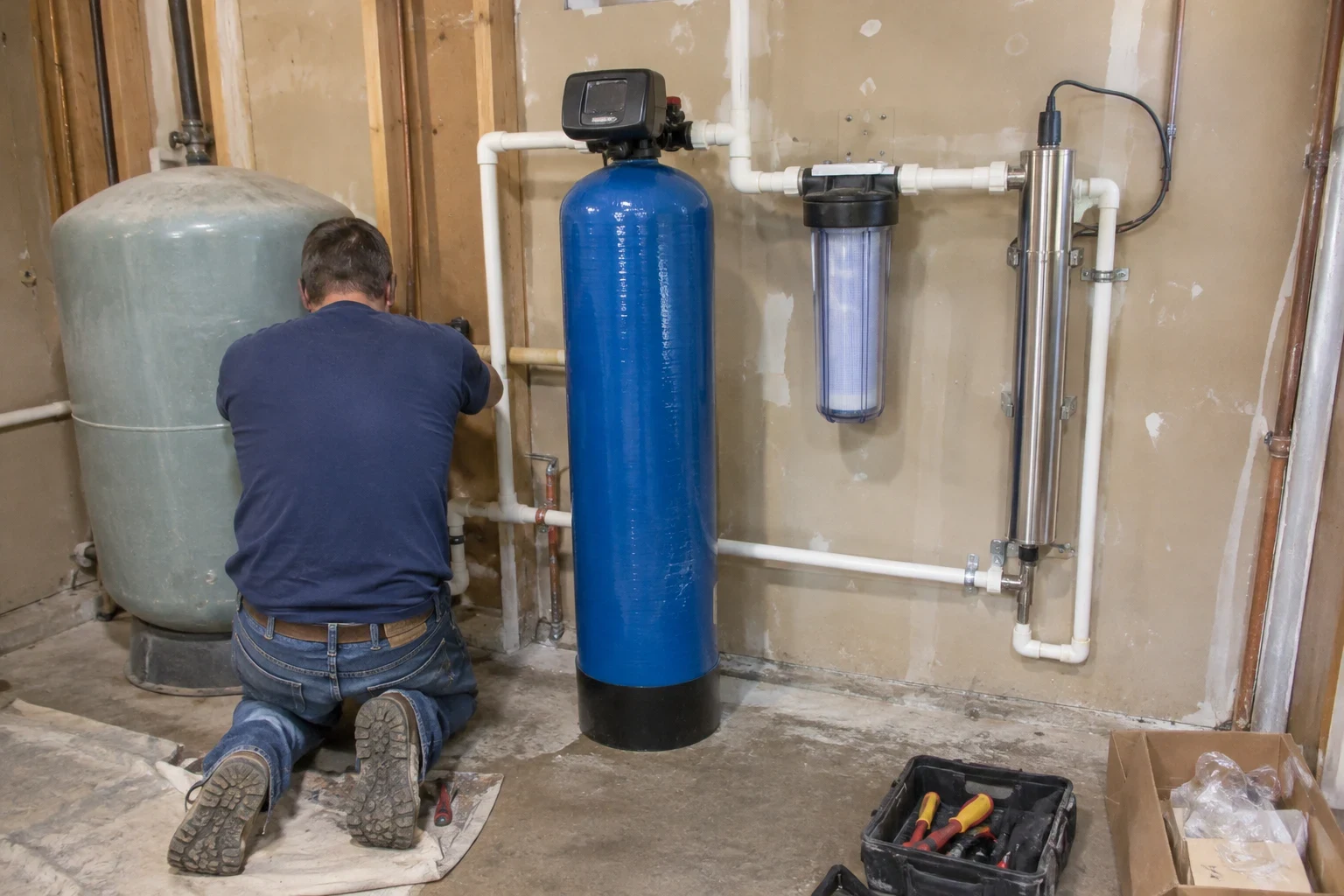
Our well water filtration goes in on the main line just after the pressure tank. A spin-down or cartridge sediment stage catches grit first. Behind it sits a backwashing media tank chosen for your problem: oxidizing media for iron and sulfur, or catalytic carbon for odor and taste. Because the media tank flushes itself on a timer, it keeps working for years instead of clogging the way a single cartridge would.
Timing matters with wells. Heavy winter rain can stir up sediment and change what the pump draws, and long dry stretches can concentrate minerals. Getting the system in before the season turns means the prefilter is already catching that shift instead of your faucet aerators.
What's included in a well filtration install
Sediment prefilter
A spin-down screen or a pleated cartridge housing, rated to the micron size your water needs. It protects the media tank and every valve downstream from sand and scale flakes.
Backwashing media tank
A fiberglass-reinforced tank with a control valve that reverses flow on a schedule to flush trapped iron and debris. The media inside is matched to what's in your water, not picked from a catalog default.
Bypass valve and isolation shutoffs
A three-valve bypass lets you send water around the system during service so the house never loses water. We add shutoffs on both sides of the prefilter so a cartridge change takes minutes.
Drain line to an approved drain
Backwash water has to go somewhere. We run the drain line with a proper air gap so wastewater can't siphon back into your supply.
Startup and walkthrough
We flush the media, set the backwash schedule and show you the gauges and the bypass. You'll know what normal looks like before we leave.
When your well water is telling you something
Reddish marks on porcelain
A ring that turns rust-red in the toilet tank or along the tub drain line means dissolved iron is oxidizing once it meets air. Manganese does the same thing but leaves streaks closer to black.
Sulfur odor at the tap
That rotten-egg smell comes from hydrogen sulfide gas carried in the groundwater, and it often gets stronger when hot water runs. Oxidizing media or catalytic carbon strips the gas out before the water reaches your fixtures.
Sand in screens and fill valves
Faucet aerators that keep packing with grit, or toilet fill valves that stick open, mean sediment is getting past the pressure tank. Over time that same grit wears down pump impellers and water heater elements.
Haze after heavy rain
When water goes cloudy following a storm, surface conditions are making their way into the well. A sediment stage traps the fine particles the casing lets through.
Coffee that tastes like metal
Iron leaves a flat, tinny edge on coffee and tea. Removing it on the main line helps every glass in your home, and an under-sink reverse osmosis unit can refine drinking water another step.
How the job runs, start to finish
- 1
A phone conversation first
You describe what your water is doing: stains, odor, grit or a change in pressure. Any past lab results for your well are worth pulling out before the call. Figures for iron, manganese and pH tell us which media will do the work.
- 2
A look at your equipment
We visit your home and check the pressure tank, pressure switch setting, pipe size and material, and where a drain is available. We measure the space so the tanks fit with room to service them. You get a written line-item estimate.
- 3
Install day
We shut the pump off at the breaker, drain pressure from the tank and cut in the bypass, prefilter and media tank. Floors get covered where we work, and we haul off packaging and pipe offcuts.
- 4
Flush, set and check
We backwash the new media until it runs clear, set the regeneration schedule for your usage and confirm pressure at a few fixtures. Then we walk you through the bypass and the filter change.
What moves the price of a well filter
Installation is free on our systems; we cover that cost, so what you're paying for is the equipment itself. The total depends mostly on what's in your water and how much of it your household pulls at once. We put each part on the written estimate so you can see what each line covers.
- What the water carries
- Sediment alone needs a simpler setup than iron plus sulfur. Higher iron or manganese levels call for oxidizing media and sometimes a larger tank.
- Pump flow and household demand
- A tank has to be sized to your peak gallons per minute. Undersize it and pressure drops when two showers run; that's why we look at the pump and pressure tank before quoting.
- Plumbing and access
- Pipe material, line size and the distance from the pressure tank to a drain all change how much fitting and running the job takes.
- Added drinking water stage
- Some homeowners add reverse osmosis at the kitchen sink for drinking and cooking water. It's a separate line on the estimate, so you can decide on it independently.
Well water filtration questions
Something not covered here? (310) 872-5891
Will a filter lower my water pressure?
Not when it's sized correctly. Every tank and cartridge has a rated flow, and we match it to your pump's output and the number of fixtures you run at once. A clogged sediment cartridge will cut pressure, which is why we install gauges on either side of it so you can see when it's due.
How much upkeep does the system need?
The media tank backwashes itself on the schedule we set, usually overnight. The sediment cartridge needs changing when the pressure gauges show a growing difference, which for many wells is a few times a year. We show you how to do it using the bypass in a few minutes.
Can it fix the sulfur smell on just my hot water?
Sometimes. If the smell shows up only on the hot side, the cause may be a reaction with the water heater's anode rod rather than the well itself. We'll check that before recommending media, so you don't buy filtration for a problem that a different anode fixes.
Where does the system go?
On the main line right after the pressure tank, so everything downstream gets filtered water. That's often a garage, a utility area or an outdoor pad near the wellhead. Outdoor installs get a cover to keep sun off the tank and control valve.
How does this differ from your city water filtration?
City water arrives already disinfected and mostly free of sediment, so city water filtration focuses on chlorine taste and odor. Well systems deal with grit, iron, manganese and sulfur, which need a prefilter and different media. The hardware looks similar, but what goes inside the tank is not.
Get cleaner water from your well
Tell us what your water is doing and we'll explain which stages make sense and why. Installation is free; we cover the cost.